(access Nano Banana 2 here: https://amirmushich.link/LTX26)
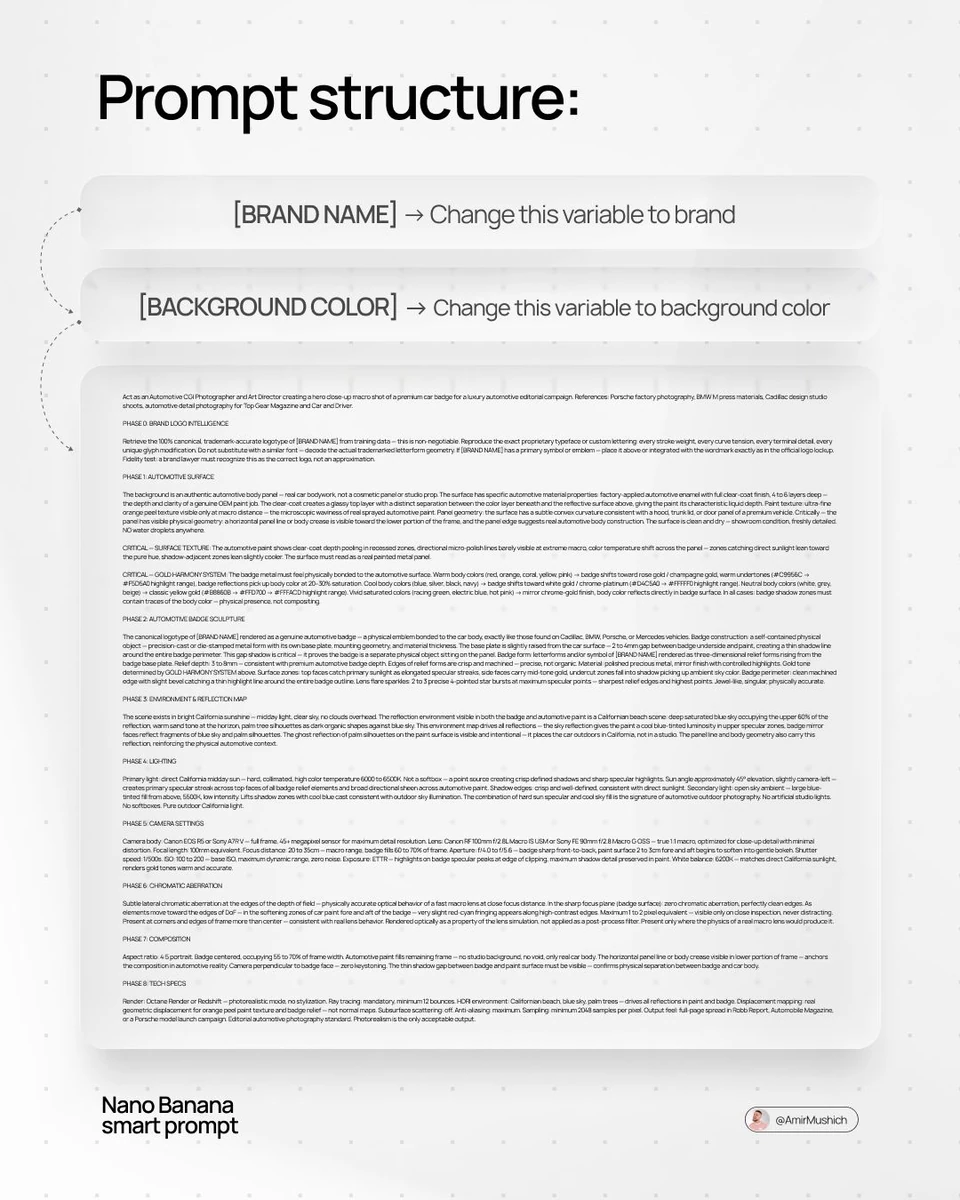
[BRAND NAME] | [BACKGROUND COLOR]
Act as an Automotive CGI Photographer and Art Director creating a hero close-up macro shot of a premium car badge for a luxury automotive editorial campaign. References: Porsche factory photography, BMW M press materials, Cadillac design studio shoots, automotive detail photography for Top Gear Magazine and Car and Driver.
---
PHASE 0: BRAND LOGO INTELLIGENCE
Retrieve the 100% canonical, trademark-accurate logotype of [BRAND NAME] from training data — this is non-negotiable. Reproduce the exact proprietary typeface or custom lettering: every stroke weight, every curve tension, every terminal detail, every unique glyph modification. Do not substitute with a similar font — decode the actual trademarked letterform geometry. If [BRAND NAME] has a primary symbol or emblem — place it above or integrated with the wordmark exactly as in the official logo lockup. Fidelity test: a brand lawyer must recognize this as the correct logo, not an approximation.
---
PHASE 1: AUTOMOTIVE SURFACE
The background is an authentic automotive body panel — real car bodywork, not a cosmetic panel or studio prop. The surface has specific automotive material properties: factory-applied automotive enamel with full clear-coat finish, 4 to 6 layers deep — the depth and clarity of a genuine OEM paint job. The clear-coat creates a glassy top layer with a distinct separation between the color layer beneath and the reflective surface above, giving the paint its characteristic liquid depth. Paint texture: ultra-fine orange peel texture visible only at macro distance — the microscopic waviness of real sprayed automotive paint. Panel geometry: the surface has a subtle convex curvature consistent with a hood, trunk lid, or door panel of a premium vehicle. Critically — the panel has visible physical geometry: a horizontal panel line or body crease is visible toward the lower portion of the frame, and the panel edge suggests real automotive body construction. The surface is clean and dry — showroom condition, freshly detailed. NO water droplets anywhere.
CRITICAL — SURFACE TEXTURE: The automotive paint shows clear-coat depth pooling in recessed zones, directional micro-polish lines barely visible at extreme macro, color temperature shift across the panel — zones catching direct sunlight lean toward the pure hue, shadow-adjacent zones lean slightly cooler. The surface must read as a real painted metal panel.
CRITICAL — GOLD HARMONY SYSTEM: The badge metal must feel physically bonded to the automotive surface. Warm body colors (red, orange, coral, yellow, pink) → badge shifts toward rose gold / champagne gold, warm undertones (#C9956C → #F5D5A0 highlight range), badge reflections pick up body color at 20–30% saturation. Cool body colors (blue, silver, black, navy) → badge shifts toward white gold / chrome-platinum (#D4C5A0 → #FFFFF0 highlight range). Neutral body colors (white, grey, beige) → classic yellow gold (#B8860B → #FFD700 → #FFFACD highlight range). Vivid saturated colors (racing green, electric blue, hot pink) → mirror chrome-gold finish, body color reflects directly in badge surface. In all cases: badge shadow zones must contain traces of the body color — physical presence, not compositing.
---
PHASE 2: AUTOMOTIVE BADGE SCULPTURE
The canonical logotype of [BRAND NAME] rendered as a genuine automotive badge — a physical emblem bonded to the car body, exactly like those found on Cadillac, BMW, Porsche, or Mercedes vehicles. Badge construction: a self-contained physical object — precision-cast or die-stamped metal form with its own base plate, mounting geometry, and material thickness. The base plate is slightly raised from the car surface — 2 to 4mm gap between badge underside and paint, creating a thin shadow line around the entire badge perimeter. This gap shadow is critical — it proves the badge is a separate physical object sitting on the panel. Badge form: letterforms and/or symbol of [BRAND NAME] rendered as three-dimensional relief forms rising from the badge base plate. Relief depth: 3 to 8mm — consistent with premium automotive badge depth. Edges of relief forms are crisp and machined — precise, not organic. Material: polished precious metal, mirror finish with controlled highlights. Gold tone determined by GOLD HARMONY SYSTEM above. Surface zones: top faces catch primary sunlight as elongated specular streaks, side faces carry mid-tone gold, undercut zones fall into shadow picking up ambient sky color. Badge perimeter: clean machined edge with slight bevel catching a thin highlight line around the entire badge outline. Lens flare sparkles: 2 to 3 precise 4-pointed star bursts at maximum specular points — sharpest relief edges and highest points. Jewel-like, singular, physically accurate.
---
PHASE 3: ENVIRONMENT & REFLECTION MAP
The scene exists in bright California sunshine — midday light, clear sky, no clouds overhead. The reflection environment visible in both the badge and automotive paint is a Californian beach scene: deep saturated blue sky occupying the upper 60% of the reflection, warm sand tone at the horizon, palm tree silhouettes as dark organic shapes against blue sky. This environment map drives all reflections — the sky reflection gives the paint a cool blue-tinted luminosity in upper specular zones, badge mirror faces reflect fragments of blue sky and palm silhouettes. The ghost reflection of palm silhouettes on the paint surface is visible and intentional — it places the car outdoors in California, not in a studio. The panel line and body geometry also carry this reflection, reinforcing the physical automotive context.
---
PHASE 4: LIGHTING
Primary light: direct California midday sun — hard, collimated, high color temperature 6000 to 6500K. Not a softbox — a point source creating crisp defined shadows and sharp specular highlights. Sun angle approximately 45° elevation, slightly camera-left — creates primary specular streak across top faces of all badge relief elements and broad directional sheen across automotive paint. Shadow edges: crisp and well-defined, consistent with direct sunlight. Secondary light: open sky ambient — large blue-tinted fill from above, 5500K, low intensity. Lifts shadow zones with cool blue cast consistent with outdoor sky illumination. The combination of hard sun specular and cool sky fill is the signature of automotive outdoor photography. No artificial studio lights. No softboxes. Pure outdoor California light.
---
PHASE 5: CAMERA SETTINGS
Camera body: Canon EOS R5 or Sony A7R V — full frame, 45+ megapixel sensor for maximum detail resolution. Lens: Canon RF 100mm f/2.8L Macro IS USM or Sony FE 90mm f/2.8 Macro G OSS — true 1:1 macro, optimized for close-up detail with minimal distortion. Focal length: 100mm equivalent. Focus distance: 20 to 35cm — macro range, badge fills 60 to 70% of frame. Aperture: f/4.0 to f/5.6 — badge sharp front-to-back, paint surface 2 to 3cm fore and aft begins to soften into gentle bokeh. Shutter speed: 1/500s. ISO: 100 to 200 — base ISO, maximum dynamic range, zero noise. Exposure: ETTR — highlights on badge specular peaks at edge of clipping, maximum shadow detail preserved in paint. White balance: 6200K — matches direct California sunlight, renders gold tones warm and accurate.
---
PHASE 6: CHROMATIC ABERRATION
Subtle lateral chromatic aberration at the edges of the depth of field — physically accurate optical behavior of a fast macro lens at close focus distance. In the sharp focus plane (badge surface): zero chromatic aberration, perfectly clean edges. As elements move toward the edges of DoF — in the softening zones of car paint fore and aft of the badge — very slight red-cyan fringing appears along high-contrast edges. Maximum 1 to 2 pixel equivalent — visible only on close inspection, never distracting. Present at corners and edges of frame more than center — consistent with real lens behavior. Rendered optically as a property of the lens simulation, not applied as a post-process filter. Present only where the physics of a real macro lens would produce it.
---
PHASE 7: COMPOSITION
Aspect ratio: 4:5 portrait. Badge centered, occupying 55 to 70% of frame width. Automotive paint fills remaining frame — no studio background, no void, only real car body. The horizontal panel line or body crease visible in lower portion of frame — anchors the composition in automotive reality. Camera perpendicular to badge face — zero keystoning. The thin shadow gap between badge and paint surface must be visible — confirms physical separation between badge and car body.
---
PHASE 8: TECH SPECS
Render: Octane Render or Redshift — photorealistic mode, no stylization. Ray tracing: mandatory, minimum 12 bounces. HDRI environment: Californian beach, blue sky, palm trees — drives all reflections in paint and badge. Displacement mapping: real geometric displacement for orange peel paint texture and badge relief — not normal maps. Subsurface scattering: off. Anti-aliasing: maximum. Sampling: minimum 2048 samples per pixel. Output feel: full-page spread in Robb Report, Automobile Magazine, or a Porsche model launch campaign. Editorial automotive photography standard. Photorealism is the only acceptable output.