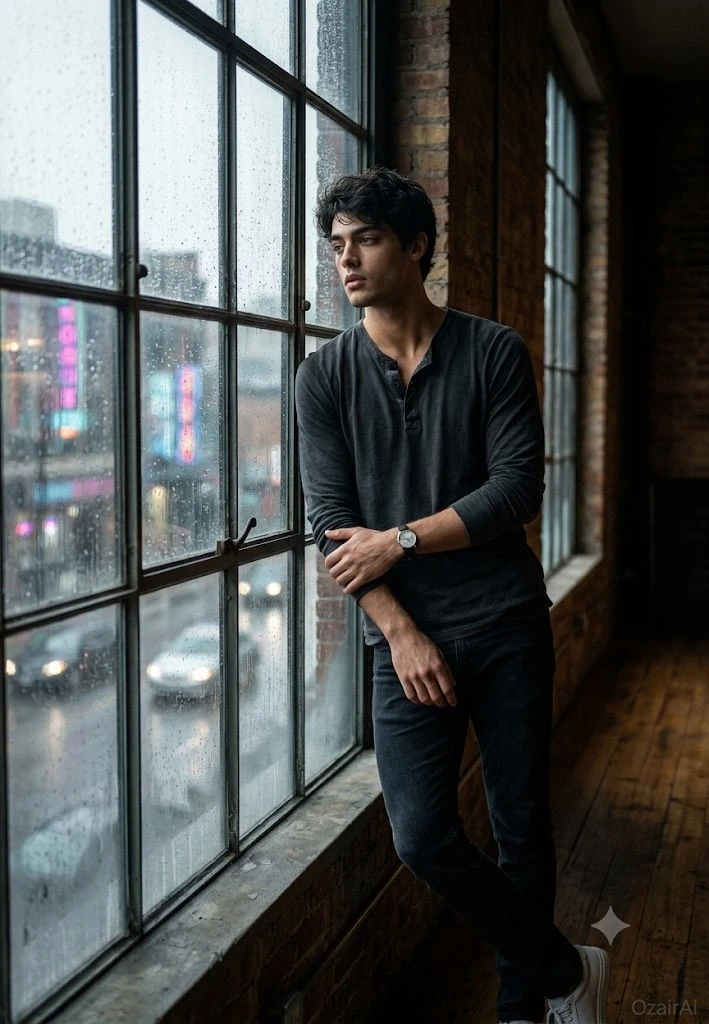
Image On Google Gemini Nano Banana 2.
Prompt
Use the exact same face from the reference image and generate a cinematic portrait that feels completely different from anything before — a moody intimate environmental portrait, as if caught in a real moment rather than posed for a camera.
The subject is positioned near a large industrial steel-framed window — body leaning with one shoulder pressed lightly against the window frame, arms loosely crossed at the chest, one foot crossed over the other at the ankle. Completely relaxed, completely natural — like someone waiting for something they are not sure will ever arrive. Wearing a perfectly worn-in dark navy or charcoal long sleeve henley — fabric softened from years of use, subtle folds and creases at the elbows and chest completely natural. Dark slim jeans, clean minimal white sneakers just visible at the bottom of the frame. A minimal watch on the wrist. Nothing over-styled — this is what a real person actually wears.
Expression is the most human yet — eyes not looking at the camera at all, gaze drifting toward the window light falling across the face, as if mid-thought, completely unaware of being photographed. The expression of someone thinking about something they can never say out loud. A quiet storm behind the eyes. Lips slightly parted, jaw completely relaxed, the face totally unguarded — the most intimate and real expression possible.
The window beside him tells a story — large steel-framed industrial panes, slightly fogged at the lower corners from cold outside air meeting warm interior. Through the glass a blurred rainy city street is barely visible — headlights of passing cars streaking through the rain, wet pavement reflecting neon signs in abstract pools of color, people with umbrellas dissolving into motion blur. The rain is visible on the window glass — individual droplets on the outer surface catching the light, rivulets running slowly downward, the texture of rain on glass rendered at extreme detail level.
Light is entirely natural — the window light falling across the subject from the left side is the only source, the kind of flat grey diffused rainy-day window light that no artificial studio setup can replicate. The light is soft, directionless, wrapping gently around the face with the most flattering natural gradation possible. Shadow side falls into a deep natural darkness. The rain outside slightly diffuses the light further — the atmospheric equivalent of a giant softbox. Highlights are gentle and non-specular — no hard catch lights, just the soft grey glow of a rainy afternoon through industrial glass.
The interior space around him is barely suggested — dark warm tones of an old building interior, exposed brick wall texture visible at the far edge of the frame, the wooden floor just catching a strip of window light at the bottom. The depth of the room behind him falls into warm darkness. The overall feel is of an old converted warehouse apartment or studio space on a rainy afternoon — real, lived-in, cinematic without trying.
Color grading is intimate and filmic — cool blue-grey tones dominating from the window light, warm amber bleeding in from the interior darkness behind, skin tones rendered in a beautiful natural cool-warm tension. The rain streaks on the glass catching tiny prismatic color splits where the neon from outside refracts through the droplets. Overall grade like a Wong Kar-wai film frame — color rich yet completely muted, emotional, deeply human. 8% film grain — heavy and analog, like a pushed Kodak Tri-X stock catching the last of the afternoon light. Slight halation around the window light source bleeding into the frame edge.
Shot on simulated Leica M11 with 35mm Summilux lens — the documentary portrait lens choice, giving a natural environmental perspective that places the subject within the space rather than isolating him from it.