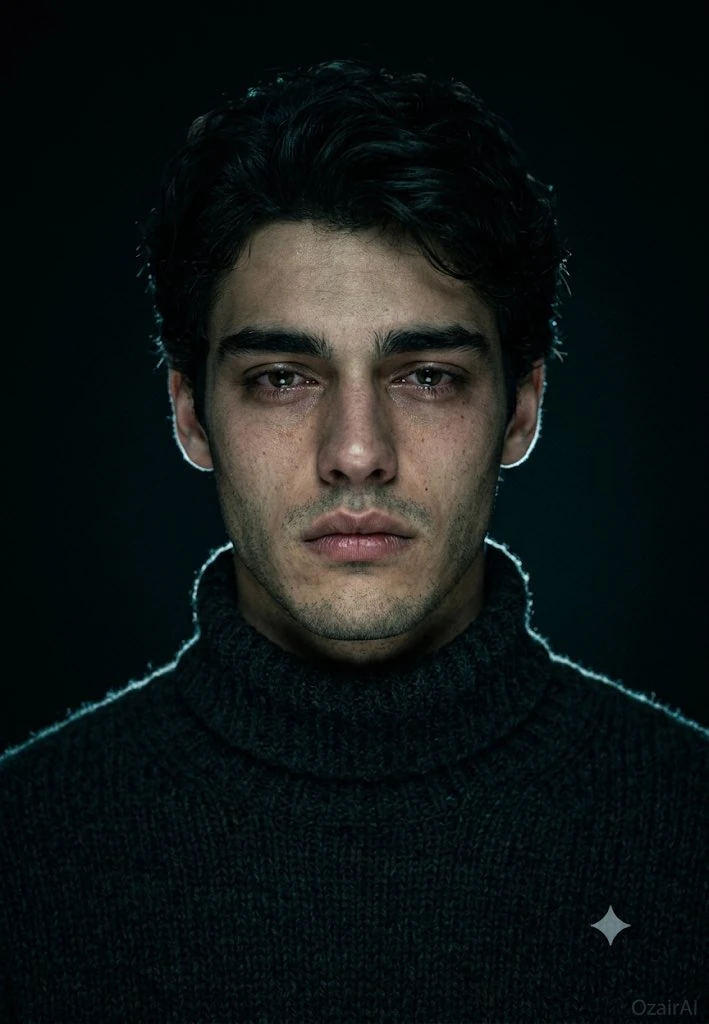
Use the exact same face from the reference image and generate a dark cinematic portrait so atmospheric and visually devastating it feels like a still frame pulled directly from an Oscar-winning film. Chest-up portrait, face occupying the emotional center of the frame.
The subject wears a heavy dark charcoal wool turtleneck — thick, textured, the fabric catching minimal light at the raised collar edges. Nothing else visible. No jewelry, no accessories, no distractions. Just the face and the darkness consuming everything around it.
Expression is the most complex and emotionally loaded yet — eyes slightly wet, not crying, but carrying the specific weight of someone who has just made an irreversible decision. The gaze is direct but distant simultaneously — looking into the lens but seeing something far beyond it. Brows pulled together by the faintest amount — not anger, not sadness — just the unbearable weight of knowing something. Lips pressed together with quiet tension. Every micro-expression on the face telling a story that needs no words. The kind of acting-level expression that wins awards.
Lighting is devastatingly beautiful and minimal — a single large softbox positioned extremely low, almost at chin level and slightly to the left, casting light upward across the face in the most unusual and cinematic direction possible. This inverted low-source lighting sculpts the face in reverse — illuminating the underside of the jaw, the lower cheeks, the bottom lip, casting deep mysterious shadows upward into the eye sockets and brow ridge, the top of the head dissolving completely into darkness. It is simultaneously unsettling and mesmerizing — the lighting choice of a true cinematographer not a photographer. A razor-thin cold blue rim light from directly behind tracing just the ears and the very top edge of the shoulders emerging from the void.
Background is absolute black — not dark grey, not near-black — genuine pure black void. But within the deepest shadow areas of the background a barely perceptible cold blue-green atmospheric depth breathes — visible only as a suggestion, giving the void three dimensions without ever showing a surface.
Skin is rendered with painful realism — the slight wetness around the eyes catching the low light source with a delicate sheen, every pore and stubble hair at maximum detail, the natural asymmetry of the face preserved completely, subtle natural redness at the inner corners of the eyes, the specific way skin compresses very slightly at the corners of pressed lips.
Color grading is cold, precise and filmic — deep teal-black shadows, cool blue-grey mid-tones, the lit areas of skin rendered in a desaturated warm tone that creates a beautiful tension against the cold background. Overall palette like a Roger Deakins night scene — every tone considered, nothing accidental. Crushed blacks that are genuinely black, highlights that never clip. 8% heavy film grain throughout — pushed film stock, analog and raw. Slight cyan tint bleeding into the darkest shadow areas.
Shot on simulated Arri Alexa 65 with Zeiss Master Prime 65mm lens — the actual cinema camera and lens combination used for Oscar-winning films, producing that unmistakable cinematic rendering that no photography camera can fully replicate. Anamorphic lens breathing and very subtle oval bokeh on any out-of-focus elements. Natural anamorphic lens flare completely absent — this image exists in pure darkness with no light sources to flare. The "OzairAI" watermark exists as a ghost-cold-blue ultra-thin text in the absolute lower-right corner, dissolving into the void. Vertical 9:13 format. Ultra photorealistic, 8K, Roger Deakins meets Emmanuel Lubezki meets Bradford Young — the portrait that makes every cinematographer put down their camera and simply stare.