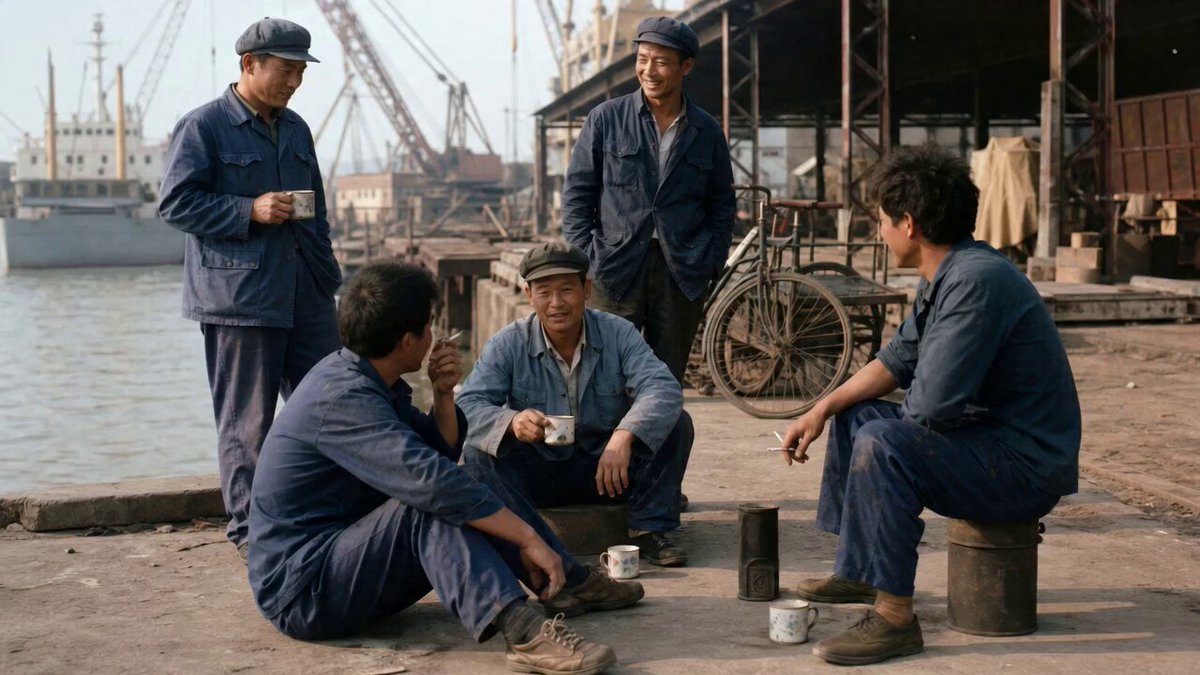
This idea is brilliant. I asked GPT-5.6 to rewrite the prompts, and the results turned out surprisingly well.
Let’s travel back to Shanghai in 1990 and see how AI can transform a still image into a living moment from the past.
Workflow:
Use GPT Image 2.0 to generate a reference image of a Shanghai dock in 1990
Image prompt: https://t.co/j5w7chpBcZ
DIRECTIVE: Generate a single hyper-realistic documentary photograph. The main subject is a group of Chinese dock workers resting and talking near the Huangpu River docks in Shanghai, China, in 1990. Natural and unposed. Shot on 35mm film with a Leica M6. No text or overlays. SCENE: Several Chinese men sitting and standing near a working dock along the Huangpu River in Shanghai. Cargo ships, cranes, warehouses, bicycles, handcarts, and industrial elements are visible in the background. The environment should accurately reflect an ordinary Chinese port area in 1990, with an authentic working-class atmosphere and no modern elements. PEOPLE: A group of Chinese male dock workers in their 30s and 40s, wearing practical, slightly worn work clothes typical of China in 1990: faded blue or gray work jackets, simple shirts, loose trousers, cloth shoes, and work caps. They are resting, smoking, drinking tea from enamel mugs, and talking casually after work. Their expressions, poses, and interactions are natural and unposed. COMPOSITION: Medium shot from a low angle, giving presence and dignity to the workers. The port elements are softly out of focus in the background. Direct but respectful framing, with the spontaneous feeling of a photograph captured during an ordinary moment of working life. TECHNICAL SPECIFICATIONS: - Camera: Leica M6, 35mm film - Film stock: Kodak Gold 200 - Style: Humanistic documentary photography with strong natural light and an authentic depiction of Chinese working-class life in 1990 - Lighting: Bright, slightly harsh natural sunlight typical of an industrial riverside port - Color: Slightly faded warm tones, restrained saturation, subtle color shifts, and authentic 1990-era film grain - Quality: Natural skin textures, realistic worn work clothing, imperfect exposure, and subtle analog-film softness - Historical accuracy: Architecture, clothing, hairstyles, bicycles, ships, tools, and industrial equipment must be appropriate to China in 1990 - Prohibitions: No text, no logos, no overlays, no smartphones, no modern vehicles, no contemporary fashion, no futuristic architecture, and no modern infrastructure
Use the reference image with Seedance 2.0 to generate the video
Video prompt:https://t.co/aVkzpqaACS
Create 15 seconds of authentic documentary footage set at the Huangpu River docks in Shanghai, China, in 1990. Use the reference image as the exact visual foundation. Preserve the same people, faces, clothing, body proportions, spatial arrangement, architecture, lighting, colors, ships, bicycles, handcarts, industrial equipment, and working-class atmosphere. Bring the photograph naturally to life. Chinese dock workers rest after work, talk quietly, smoke cigarettes, drink tea from enamel mugs, and observe the port. Their gestures are subtle, relaxed, realistic, and unposed. Keep all faces and identities consistent with the reference image. In the background, workers move cargo, bicycles pass, ships drift slowly, cranes operate in the distance, and ropes and clothing move gently in the river breeze. Everything must be historically accurate to Shanghai in 1990. Use natural documentary cuts every 1.5–2.5 seconds, showing different workers, small groups, faces, hands, cigarettes, enamel mugs, bicycles, cargo, and wider views of the same dock from varied angles. All shots remain in the same location, time, lighting, and continuous moment. The camera is handheld and slightly shaky, with constant organic movement, imperfect framing, subtle focus breathing, occasional motion blur, and minor exposure changes, as if the filmmaker is walking through the dock. Use direct, respectful framing. No smooth stabilization, dramatic camera moves, slow motion, or polished commercial cinematography. The footage looks like genuine 35mm color film from 1990: visible grain, slightly faded warm colors, restrained saturation, soft contrast, subtle flicker, natural skin texture, imperfect exposure, and occasional dust or scratches. It must not look digitally sharp, glossy, modern, or AI-generated. Natural location sound only: quiet Mandarin and Shanghainese conversations, ship horns, river water, bicycle bells, footsteps, cargo, metal tools, cranes, and wind. No music, narration, subtitles, or artificial sound effects. The result must feel like recently discovered archival footage of everyday Chinese dock workers in Shanghai in 1990. No text, logos, modern clothing, smartphones, contemporary vehicles, modern skyline, facial distortion, identity changes, duplicated people, morphing bodies, artificial gestures, or anachronistic objects.